
Tree Care Knowledge Center
Why Young Tree Pruning Is One of the Best Investments a Homeowner Can Make
When most people think about tree care, they think about removing dead branches, storm damage cleanup, or taking down hazardous trees. What many homeowners don't realize is that some of the most important tree work happens long before a tree ever becomes a problem.
One of the most valuable services an arborist can provide is structural pruning of young trees.
The Hidden Problem Growing Inside Young Trees
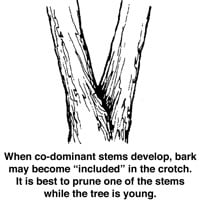
Many trees naturally develop multiple competing leaders as they grow. These are known as co-dominant stems - two or more trunks of similar size competing for dominance.
At first, this may seem harmless. The tree appears healthy and vigorous. However, as the stems enlarge, they often form narrow, V-shaped unions with bark trapped between them. Arborists refer to this condition as included bark.
Unlike a strong branch attachment where wood grows together, included bark prevents a solid connection from forming. Over time, the tree develops a structural weak point that becomes increasingly vulnerable to failure.
Why This Matters in Northern Illinois
Northern Illinois trees are regularly subjected to challenging weather conditions, including:
- Heavy wet snow
- Ice accumulation
- Strong thunderstorms
- High winds
- Summer foliage loads
These weather events place tremendous stress on weak branch unions.
Many common landscape trees are especially prone to developing structural defects if left unpruned, including:
- Freeman Maple
- Silver Maple
- Honey Locust
- Bradford Pear
- Linden
- Red Maple
When these trees reach maturity, a weak union that could have been corrected in a few minutes may eventually split apart, resulting in property damage, costly pruning, or complete tree removal.
The Best Time to Correct a Defect
The ideal time to address structural issues is while the tree is still young.
A one-inch competing leader can often be corrected with a few small pruning cuts. The resulting wounds are small, and the tree can quickly compartmentalize the injury.
Twenty years later, that same defect may involve stems twelve inches or larger in diameter. Correcting the problem at that stage may require extensive reduction pruning, cabling, bracing, or may be impossible to correct entirely.
In arboriculture, small cuts made early are almost always preferable to large cuts made later.
What Arborists Look For
During a structural pruning inspection, an arborist evaluates:
- Competing leaders
- Included bark
- Poor branch spacing
- Oversized lower limbs
- Unbalanced crown development
- Future clearance issues
The goal is not to make the tree look heavily pruned. Instead, the goal is to guide the tree's development so that it matures into a stronger, safer, and longer-lived specimen.
A Proactive Approach to Tree Care
Most tree work is reactive. A storm breaks a branch. A tree declines. A problem becomes visible.
Structural pruning is different.
It is an investment in the future health and stability of the tree. By addressing defects while they are small, homeowners can often avoid much larger expenses and risks later in the tree's life.
For many young landscape trees, a short pruning visit every few years can significantly improve long-term structure and reduce the likelihood of major failures.
Schedule a Young Tree Evaluation
If you have trees planted within the last 5-15 years, now is the ideal time to evaluate their structure. Early intervention can prevent serious defects from developing and help your trees reach maturity safely and beautifully.
At Axis Tree Care Company, we specialize in helping property owners identify and correct structural issues before they become costly problems.
The best time to prevent a tree failure is often decades before it would have happened.